
مناسك العمرة
Umrah Rites
Rites de la Omra
شرح مبسّط لأعمال العمرة خطوةً بخطوة مع الأدعية الثابتة والمشهورة. أركان العمرة ثلاثة: الإحرام والطواف والسعي، ويجب بعدها الحلق أو التقصير.
A simple step-by-step guide to the acts of Umrah, with the authentic and well-known supplications. The pillars of Umrah are three: ihram, tawaf, and sa'i, followed by the obligatory shaving or shortening of the hair.
Guide simple, étape par étape, des actes de la Omra, avec les invocations authentiques et les plus connues. Les piliers de la Omra sont trois : l’ihram, le tawaf et le sa’y, suivis du rasage ou du raccourcissement des cheveux, qui est obligatoire.
حكمها: واجبة مرة في العمر على المستطيع عند الشافعية والحنابلة، وسنة مؤكدة عند الحنفية والمالكية.
Ruling: it is obligatory once in a lifetime for those who are able, according to the Shafi'i and Hanbali schools, and a confirmed Sunnah according to the Hanafi and Maliki schools.
Statut : elle est obligatoire une fois dans la vie pour celui qui en a la capacité selon les écoles chafiite et hanbalite, et une sunna fortement recommandée selon les écoles hanafite et malikite.
ملخص العمرة للتحميل
Download the Umrah Summary
Télécharger le résumé de la Omra
صور جاهزة للحفظ على هاتفك تضم جميع الخطوات مع الأدعية. اضغط «عرض» للمعاينة أو «تحميل» لحفظ الصورة.
Ready-to-save images for your phone with every step and supplication. Tap View to preview or Download to save an image.
Des images prêtes à enregistrer sur votre téléphone, avec toutes les étapes et les invocations. Appuyez sur « Voir » pour l’aperçu ou sur « Télécharger » pour enregistrer l’image.
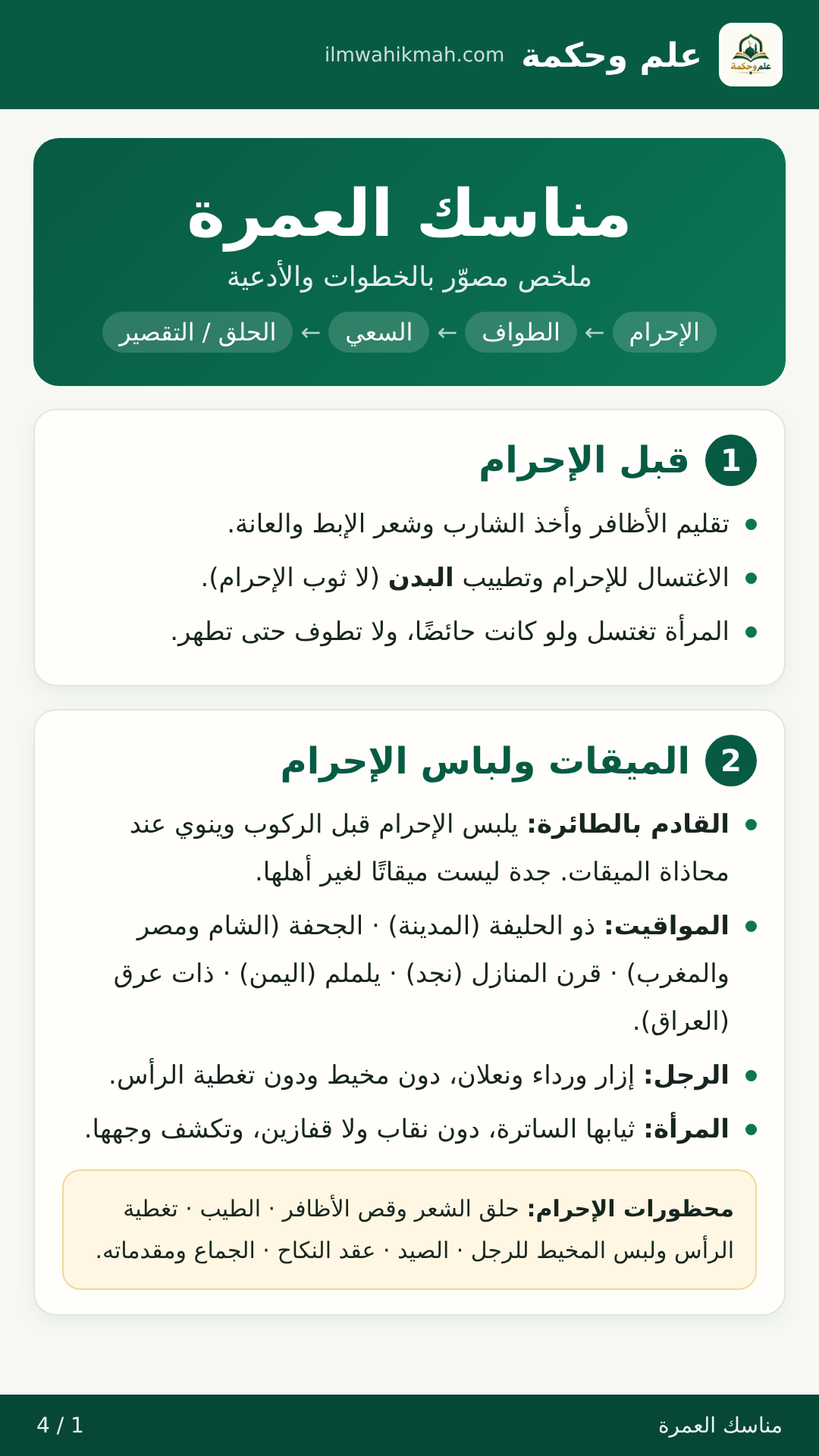
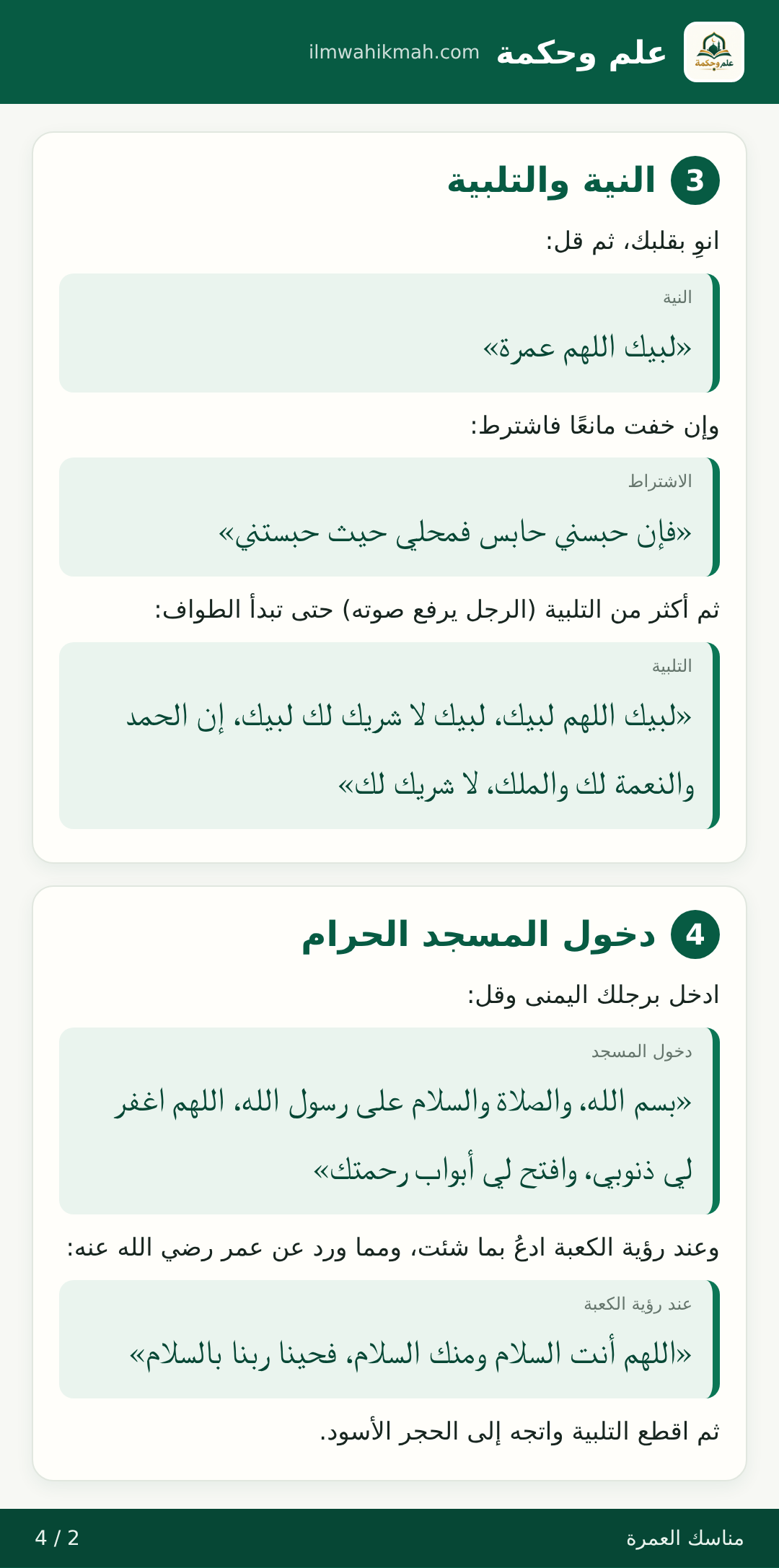
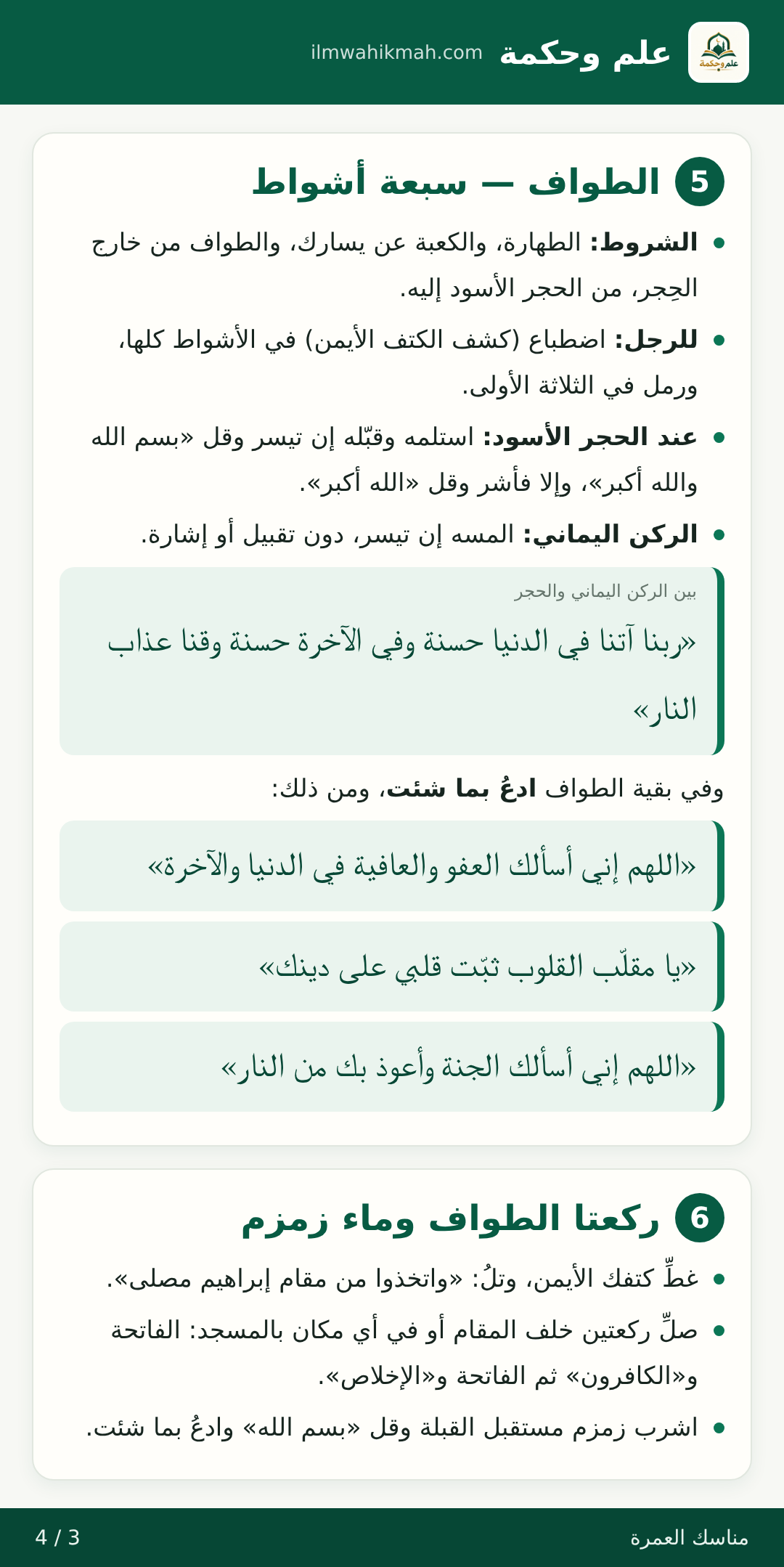
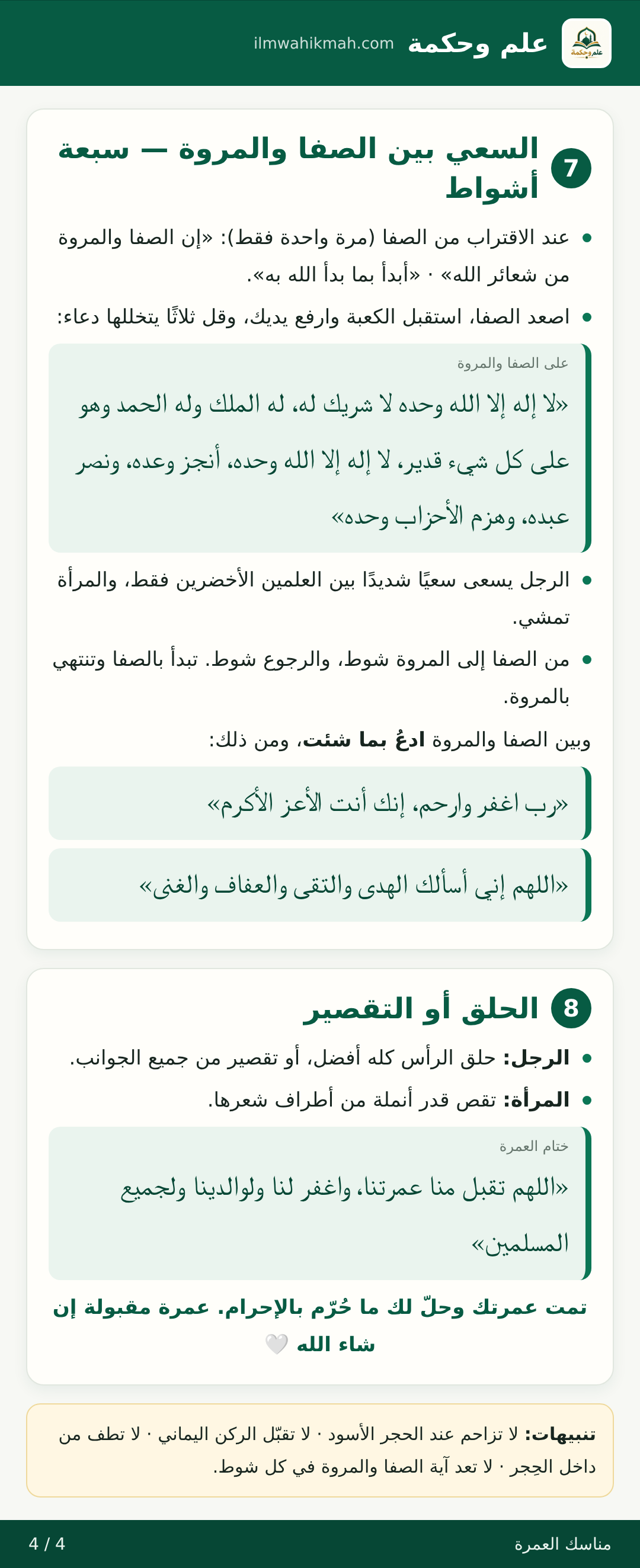
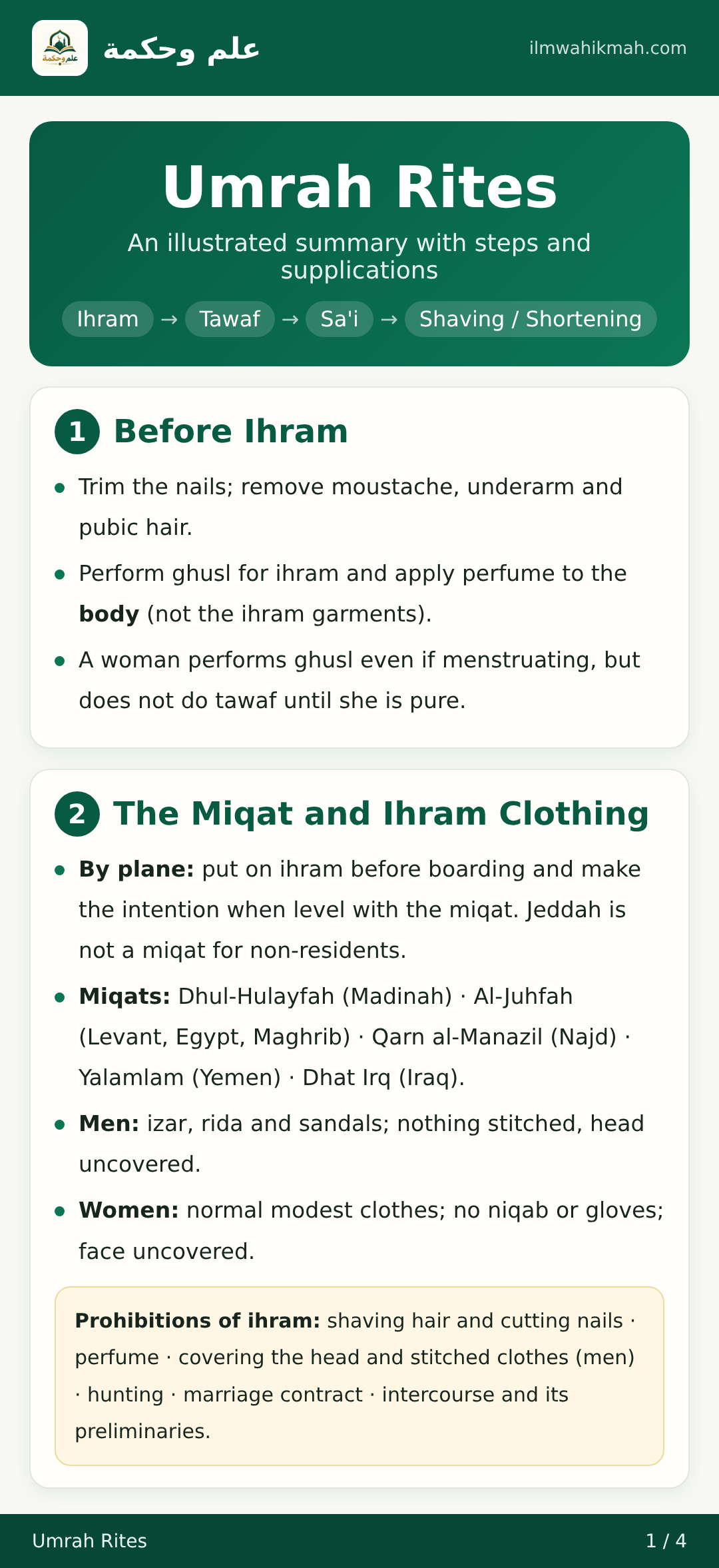
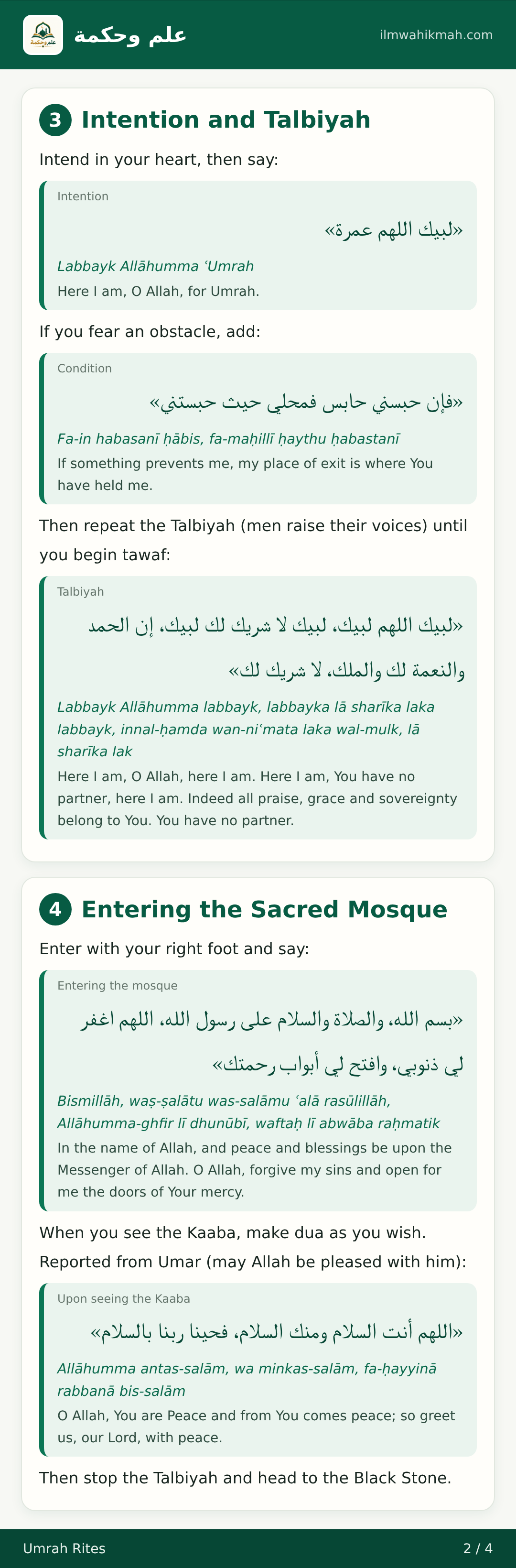
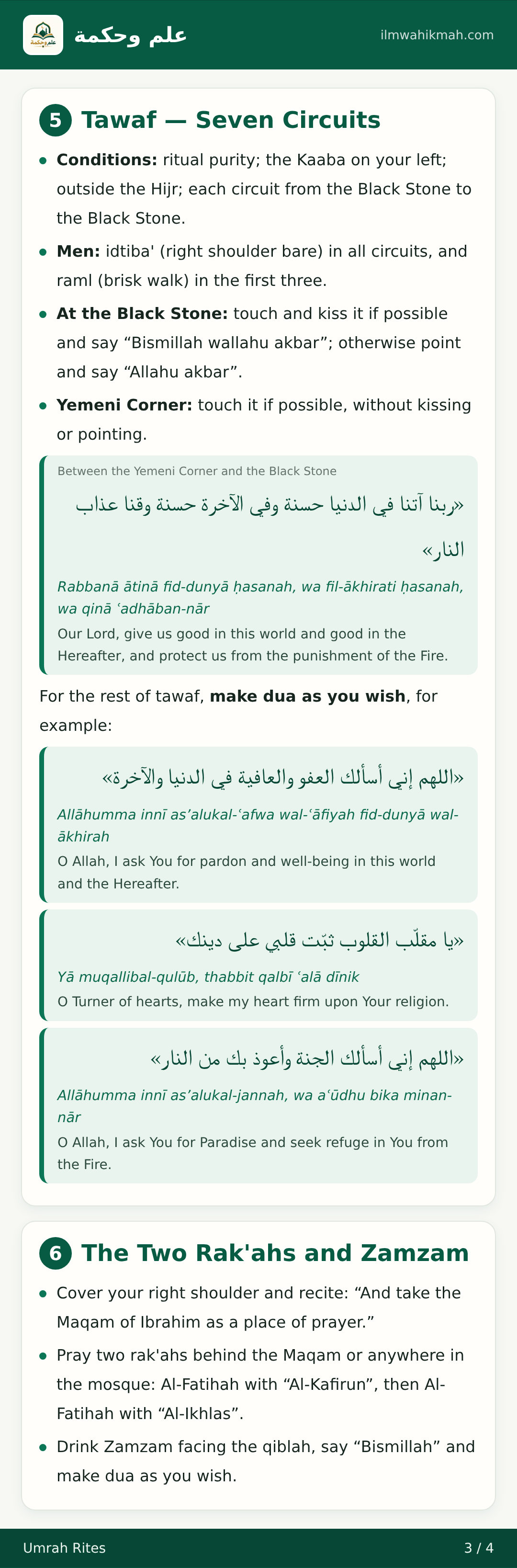
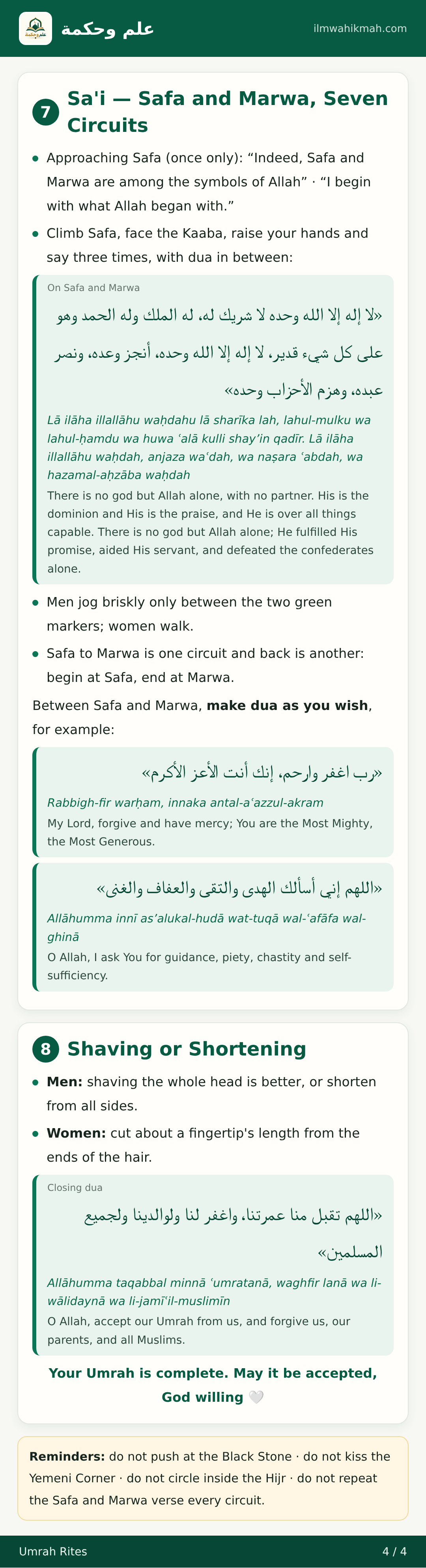
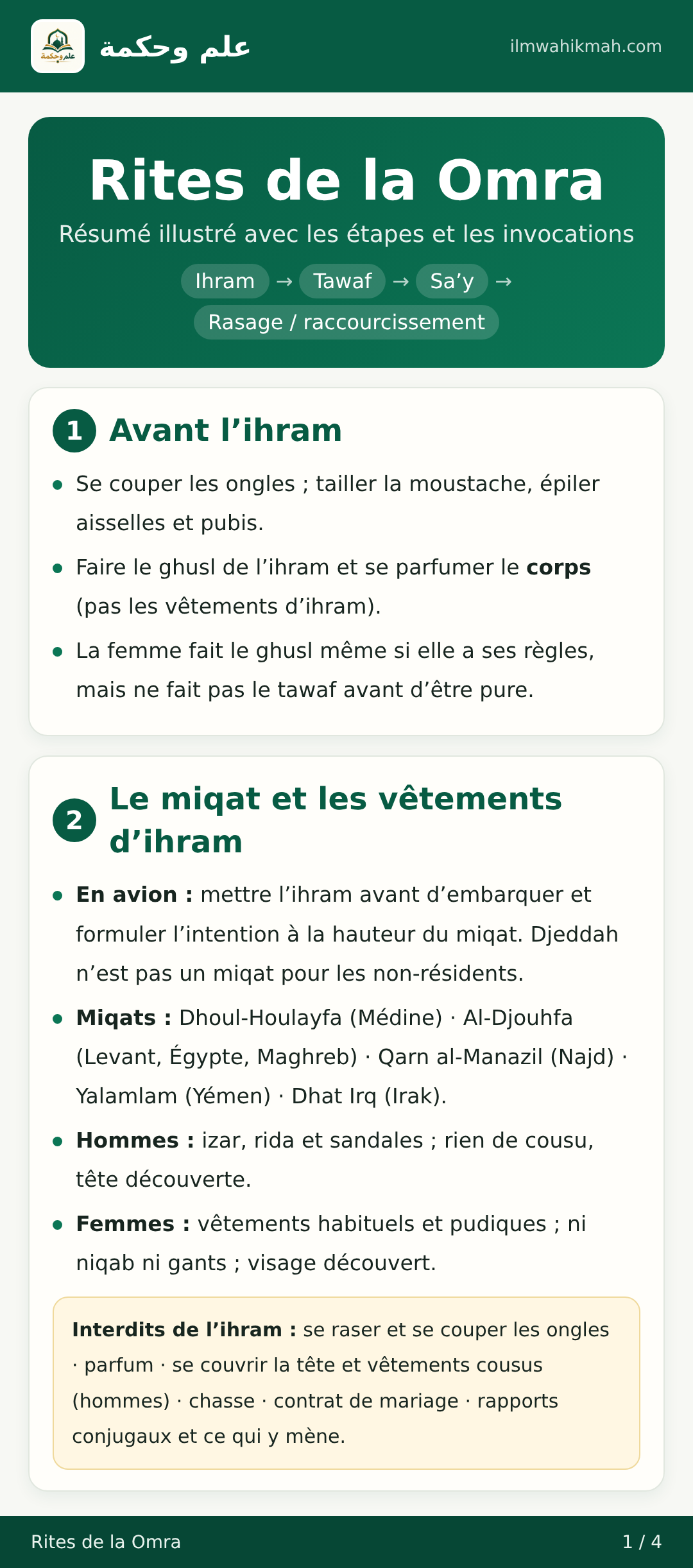
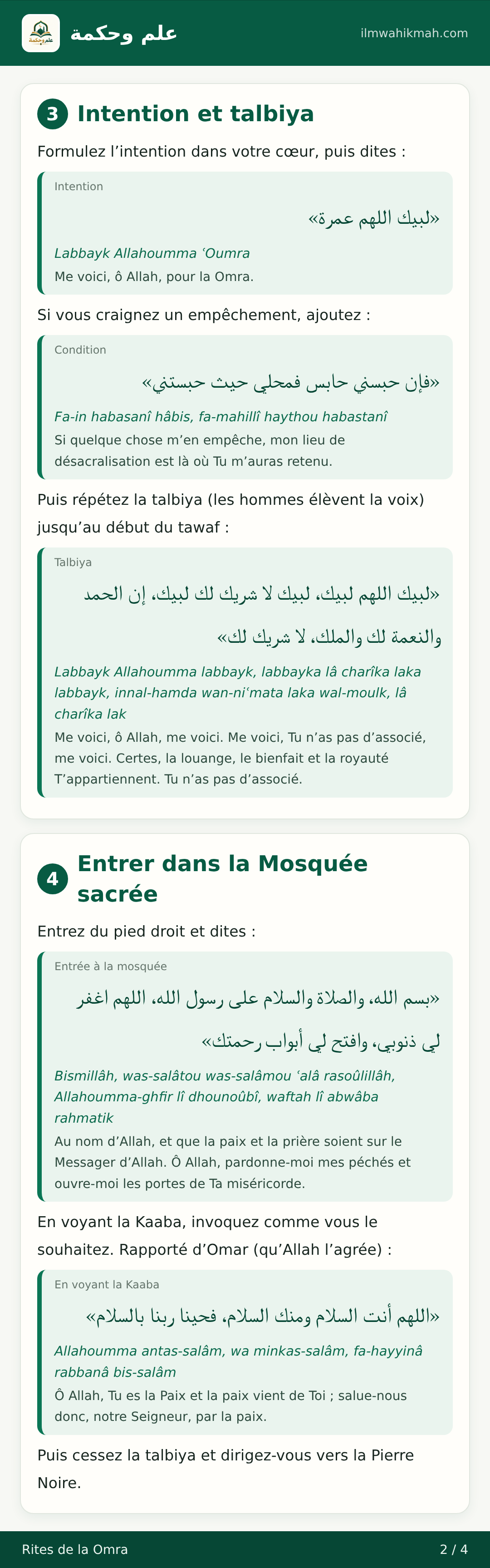
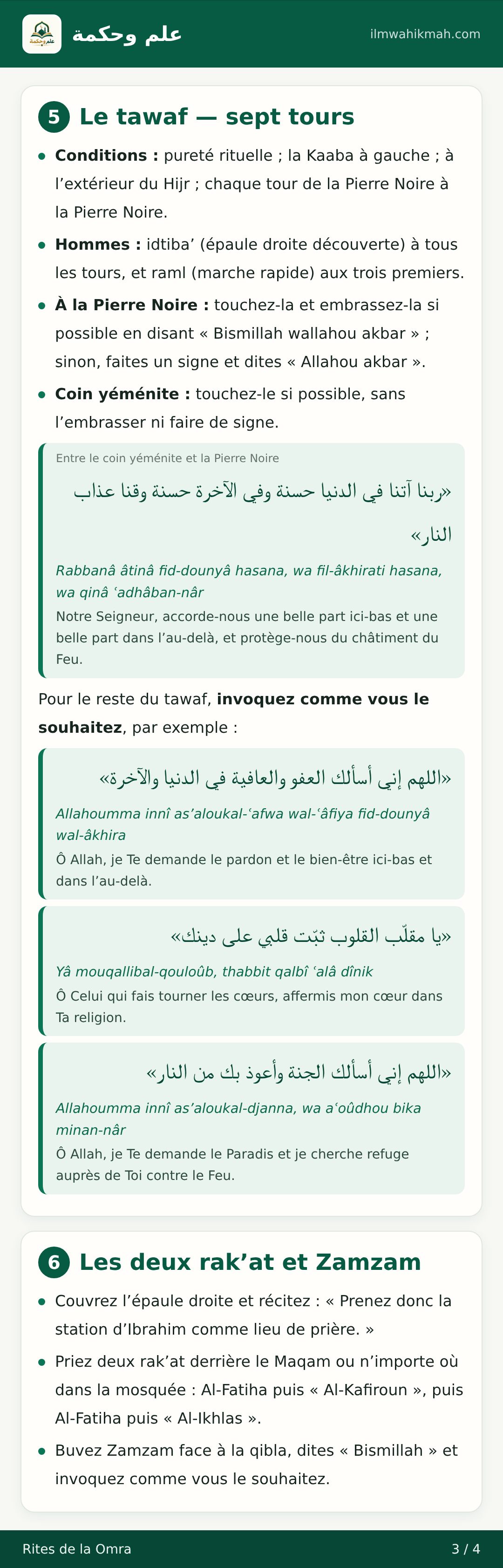
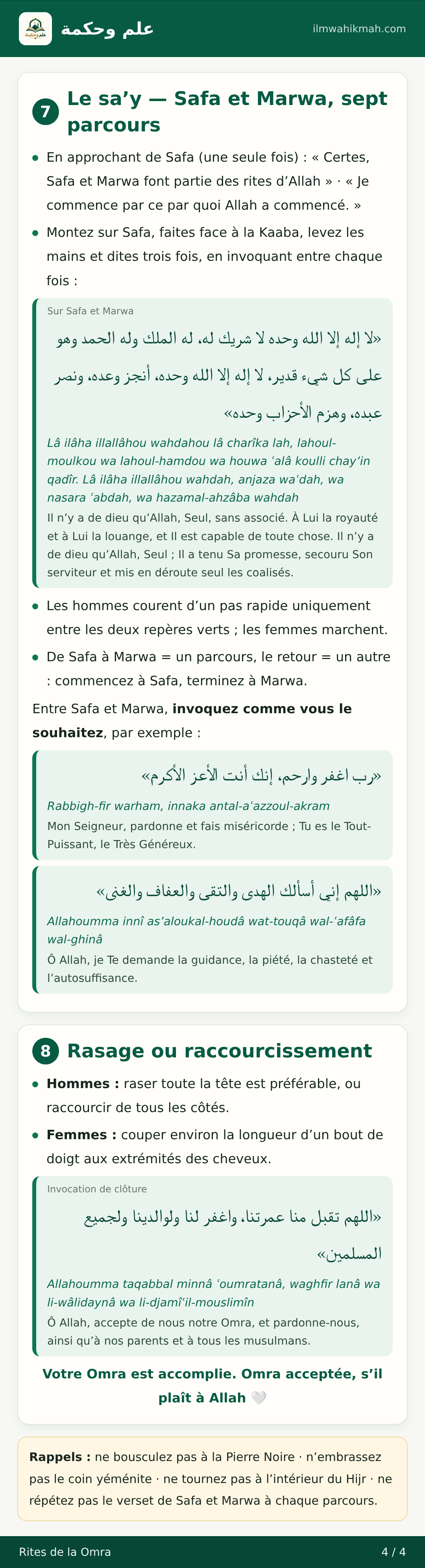
على الهاتف: عند الضغط على «تحميل» تظهر قائمة المشاركة، اختر منها «حفظ الصورة» أو «Save Image» لتُحفظ في تطبيق الصور.
On your phone: tapping Download opens the share sheet. Choose “Save Image” to save it to your Photos app.
Sur votre téléphone : en appuyant sur Télécharger, le menu de partage s’ouvre. Choisissez « Enregistrer l’image » pour la sauvegarder dans votre application Photos.
1قبل الإحرامBefore IhramAvant l’ihram
يُستحب فعل ما يلي قبل نية الإحرام، لأنه يُمنع بعدها:
It is recommended to do the following before making the intention for ihram, since these things become prohibited afterwards:
Il est recommandé de faire ce qui suit avant de formuler l’intention d’entrer en ihram, car ces actes deviennent interdits ensuite :
- تقليم الأظافر، وأخذ الشارب وشعر الإبط والعانة.
- الاغتسال للإحرام، وتطييب البدن (لا ثوب الإحرام).
- المرأة تغتسل ولو كانت حائضًا أو نفساء، لكنها لا تطوف حتى تطهر.
- Trim the nails, and remove moustache, underarm, and pubic hair.
- Perform ghusl (a full bath) for ihram, and apply perfume to the body (not to the ihram garments).
- A woman performs ghusl even if she is menstruating or in postnatal bleeding, but she does not perform tawaf until she is pure.
- Se couper les ongles, se tailler la moustache, s’épiler les aisselles et le pubis.
- Faire le ghusl (grande ablution) de l’ihram et se parfumer le corps (pas les vêtements d’ihram).
- La femme fait le ghusl même si elle a ses règles ou des lochies, mais elle ne fait pas le tawaf avant d’être pure.
2الميقات ولباس الإحرامThe Miqat and Ihram ClothingLe miqat et les vêtements d’ihram
لا يجوز تجاوز الميقات دون إحرام لمن أراد العمرة:
A person intending Umrah may not pass the miqat without entering ihram:
Celui qui veut accomplir la Omra ne doit pas dépasser le miqat sans entrer en ihram :
| الميقات | لمن؟ |
|---|---|
| ذو الحليفة (أبيار علي) | أهل المدينة ومن مرّ بها |
| الجحفة (قرب رابغ) | أهل الشام ومصر والمغرب ومن مرّ بها |
| قرن المنازل (السيل الكبير) | أهل نجد والطائف |
| يلملم (السعدية) | أهل اليمن |
| ذات عرق | أهل العراق |
| Miqat | For whom? |
|---|---|
| Dhul-Hulayfah (Abyar Ali) | People of Madinah and those passing through it |
| Al-Juhfah (near Rabigh) | People of the Levant, Egypt, and the Maghrib, and those passing through it |
| Qarn al-Manazil (As-Sayl al-Kabir) | People of Najd and Taif |
| Yalamlam (As-Sa'diyah) | People of Yemen |
| Dhat Irq | People of Iraq |
| Miqat | Pour qui ? |
|---|---|
| Dhoul-Houlayfa (Abyar Ali) | Les gens de Médine et ceux qui y passent |
| Al-Djouhfa (près de Rabigh) | Les gens du Levant, d’Égypte et du Maghreb, et ceux qui y passent |
| Qarn al-Manazil (As-Sayl al-Kabir) | Les gens du Najd et de Taïf |
| Yalamlam (As-Sa’diya) | Les gens du Yémen |
| Dhat Irq | Les gens d’Irak |
- القادم بالطائرة: يلبس الإحرام قبل الركوب، وينوي عند محاذاة الميقات حين تعلن الطائرة. ولا تُعدّ جدة ميقاتًا لغير أهلها.
- المقيم بمكة: يخرج إلى الحل (كالتنعيم) ويحرم منه.
- يُستحب أن يكون الإحرام بعد صلاة فريضة إن وافق وقتها.
- Travelling by plane: put on the ihram clothing before boarding, and make the intention when the plane is level with the miqat, as the crew announces. Jeddah is not a miqat for anyone except its residents.
- Residents of Makkah: go out to the Hill (outside the Haram boundary), such as Tan'im, and enter ihram from there.
- It is recommended to enter ihram after an obligatory prayer if the time coincides.
- En avion : mettre l’ihram avant d’embarquer et formuler l’intention lorsque l’avion arrive à la hauteur du miqat, selon l’annonce de l’équipage. Djeddah n’est pas un miqat, sauf pour ses habitants.
- Les résidents de La Mecque : sortent en dehors des limites du Haram (le Hill), par exemple à Tan’im, et entrent en ihram de là.
- Il est recommandé d’entrer en ihram après une prière obligatoire si le moment coïncide.
الرجل: يخلع المخيط (ما فُصّل على قدر البدن) ويلبس إزارًا يستر من السرة إلى ما تحت الركبة، ورداءً يغطي به كتفيه، ونعلين يكشفان الكعبين. لا يغطي رأسه. ويجوز الحزام والساعة والخاتم.
Men: remove stitched clothing (anything tailored to the shape of the body) and wear an izar (lower wrap) covering from the navel to below the knee, a rida (upper wrap) over the shoulders, and sandals that leave the ankles uncovered. Do not cover the head. A belt, watch, and ring are permitted.
L’homme : retire les vêtements cousus (ce qui est taillé à la forme du corps) et porte un izar (pagne) allant du nombril au-dessous du genou, un rida (drap) sur les épaules, et des sandales laissant les chevilles découvertes. Il ne se couvre pas la tête. La ceinture, la montre et la bague sont permises.
المرأة: تحرم في ثيابها الساترة دون زينة، ولا تلبس النقاب ولا القفازين، وتغطي رأسها وتكشف وجهها، فإن مرّ بها رجال أجانب أسدلت الخمار على وجهها دون أن يلامسه.
Women: enter ihram in their normal modest clothes without adornment. She does not wear the niqab or gloves; she covers her head and uncovers her face. If unrelated men pass by, she lowers her veil over her face without letting it touch her face.
La femme : entre en ihram dans ses vêtements habituels et pudiques, sans parure. Elle ne porte ni niqab ni gants ; elle se couvre la tête et laisse le visage découvert. Si des hommes étrangers passent près d’elle, elle abaisse son voile sur son visage sans qu’il le touche.
محظورات الإحرام
Prohibitions of Ihram
Interdits de l’ihram
- حلق الشعر وإزالته، وقص الأظافر.
- التطيب في البدن أو الثوب.
- تغطية الرأس للرجل، ولبس المخيط للرجل، والنقاب والقفازان للمرأة.
- قتل الصيد البري أو إيذاؤه، وقطع شجر الحرم.
- عقد النكاح والخطبة.
- الجماع ومقدماته (وهو يفسد العمرة).
- Shaving or removing hair, and cutting nails.
- Using perfume on the body or clothes.
- Covering the head and wearing stitched clothing for men; the niqab and gloves for women.
- Killing or harassing land game, and cutting the trees of the Haram.
- Contracting a marriage or proposing.
- Intercourse and its preliminaries (intercourse invalidates the Umrah).
- Se raser ou s’épiler, et se couper les ongles.
- Se parfumer le corps ou les vêtements.
- Se couvrir la tête et porter des vêtements cousus pour l’homme ; le niqab et les gants pour la femme.
- Tuer ou importuner le gibier terrestre, et couper les arbres du Haram.
- Conclure un mariage ou faire une demande en mariage.
- Les rapports conjugaux et ce qui y mène (les rapports invalident la Omra).
3النية والتلبيةIntention and TalbiyahIntention et talbiya
انوِ بقلبك الدخول في العمرة، ثم قل بلسانك:
Intend in your heart to enter Umrah, then say aloud:
Formulez l’intention dans votre cœur d’entrer dans la Omra, puis dites à voix haute :
«لبيك اللهم عمرة»وفي أشهر الحج لمن سيحج متمتعًا: «لبيك عمرة متمتعًا بها إلى الحج»Labbayk Allāhumma ʿUmrah“Labbayk Allahumma 'umrah” (Here I am, O Allah, for Umrah).In the months of Hajj, for one who will perform Hajj with tamattu': “Labbayk 'umratan mutamatti'an biha ilal-Hajj”.Labbayk Allahoumma ʿOumra« Me voici, ô Allah, pour la Omra. »Pendant les mois du Hajj, pour celui qui accomplira le Hajj en tamattu’ : « Labbayk ’oumratan moutamatti’an biha ilal-Hajj ».
وإن خفت مانعًا (مرض أو عائق) فاشترط:
If you fear an obstacle (illness or something preventing you), make a condition:
Si vous craignez un empêchement (maladie ou autre obstacle), posez une condition :
«فإن حبسني حابس فمحلي حيث حبستني»Fa-in habasanī ḥābis, fa-maḥillī ḥaythu ḥabastanī“If something prevents me, then my place of exit is where You have held me.”Fa-in habasanî hâbis, fa-mahillî haythou habastanî« Si quelque chose m’en empêche, alors mon lieu de désacralisation est là où Tu m’auras retenu. »
ثم أكثر من التلبية، والرجل يرفع بها صوته والمرأة تُسمع نفسها:
Then recite the Talbiyah often. Men raise their voices; women say it so that they can hear themselves:
Puis multipliez la talbiya. Les hommes élèvent la voix ; les femmes la disent de façon à s’entendre elles-mêmes :
«لبيك اللهم لبيك، لبيك لا شريك لك لبيك، إن الحمد والنعمة لك والملك، لا شريك لك»Labbayk Allāhumma labbayk, labbayka lā sharīka laka labbayk, innal-ḥamda wan-niʿmata laka wal-mulk, lā sharīka lak“Here I am, O Allah, here I am. Here I am, You have no partner, here I am. Indeed all praise, grace, and sovereignty belong to You. You have no partner.”Labbayk Allahoumma labbayk, labbayka lâ charîka laka labbayk, innal-hamda wan-niʿmata laka wal-moulk, lâ charîka lak« Me voici, ô Allah, me voici. Me voici, Tu n’as pas d’associé, me voici. Certes, la louange, le bienfait et la royauté T’appartiennent. Tu n’as pas d’associé. »
وتستمر فيها حتى تبدأ الطواف.
Continue until you begin tawaf.
Continuez jusqu’au début du tawaf.
4دخول المسجد الحرامEntering the Sacred MosqueEntrer dans la Mosquée sacrée
ادخل برجلك اليمنى وقل:
Enter with your right foot and say:
Entrez du pied droit et dites :
«بسم الله، والصلاة والسلام على رسول الله، اللهم اغفر لي ذنوبي، وافتح لي أبواب رحمتك»Bismillāh, waṣ-ṣalātu was-salāmu ʿalā rasūlillāh, Allāhumma-ghfir lī dhunūbī, waftaḥ lī abwāba raḥmatik“In the name of Allah, and peace and blessings be upon the Messenger of Allah. O Allah, forgive my sins and open for me the doors of Your mercy.”Bismillâh, was-salâtou was-salâmou ʿalâ rasoûlillâh, Allahoumma-ghfir lî dhounoûbî, waftah lî abwâba rahmatik« Au nom d’Allah, et que la paix et la prière soient sur le Messager d’Allah. Ô Allah, pardonne-moi mes péchés et ouvre-moi les portes de Ta miséricorde. »
وعند رؤية الكعبة ادعُ بما شئت، ومن المأثور عن عمر رضي الله عنه:
When you see the Kaaba, supplicate with whatever you wish. Among the narrated supplications, from Umar (may Allah be pleased with him):
En voyant la Kaaba, invoquez comme vous le souhaitez. Parmi les invocations rapportées, d’après Omar (qu’Allah l’agrée) :
«اللهم أنت السلام ومنك السلام، فحينا ربنا بالسلام»Allāhumma antas-salām, wa minkas-salām, fa-ḥayyinā rabbanā bis-salām“O Allah, You are Peace and from You comes peace, so greet us, our Lord, with peace.”Allahoumma antas-salâm, wa minkas-salâm, fa-hayyinâ rabbanâ bis-salâm« Ô Allah, Tu es la Paix et la paix vient de Toi ; salue-nous donc, notre Seigneur, par la paix. »
ثم توجّه إلى الحجر الأسود لتبدأ الطواف، وأوقف التلبية.
Then head to the Black Stone to begin tawaf, and stop the Talbiyah.
Puis cessez la talbiya et dirigez-vous vers la Pierre Noire.
5الطواف (سبعة أشواط)Tawaf (Seven Circuits)Le tawaf (sept tours)
الشروط: الطهارة وستر العورة، وأن تكون الكعبة عن يسارك، وأن يكون الطواف من خارج الحِجر (حِجر إسماعيل)، وتبدأ كل شوط من الحجر الأسود وتنتهي عنده.
Conditions: ritual purity and covering the awrah; the Kaaba on your left; the tawaf must be outside the Hijr (Hijr Ismail); and each circuit begins and ends at the Black Stone.
Conditions : la pureté rituelle et le fait de couvrir l’aoura ; la Kaaba à votre gauche ; le tawaf se fait à l’extérieur du Hijr (Hijr Ismaïl) ; et chaque tour commence et se termine à la Pierre Noire.
- الاضطباع (للرجل فقط): اجعل وسط الرداء تحت إبطك الأيمن وطرفيه على كتفك الأيسر، يبقى الكتف الأيمن مكشوفًا في الأشواط السبعة كلها.
- البداية: قف عند الخط المقابل للحجر الأسود، واستقبله، ثم استلمه بيمينك وقبّله إن تيسر دون مزاحمة وقل «بسم الله والله أكبر». فإن لم تستطع فأشر إليه بيدك وقل «الله أكبر» ولا تقبّل يدك. وافعل ذلك كلما حاذيته في كل شوط.
- الرمل (للرجل فقط): الإسراع مع تقارب الخطى في الأشواط الثلاثة الأولى، ويمشي عاديًا في الأربعة الباقية. ويسقط عند الزحام.
- الركن اليماني: استلمه بيمينك إن تيسر، ولا تقبّله ولا تشر إليه إن لم تستطع.
- بين الركن اليماني والحجر الأسود في كل شوط قل:
- Idtiba' (men only): place the middle of the rida under your right armpit with both ends over your left shoulder, leaving the right shoulder bare in all seven circuits.
- Starting: stand at the line facing the Black Stone, face it, then touch it with your right hand and kiss it if possible without pushing, saying “Bismillah wallahu akbar”. If you cannot, point to it with your hand and say “Allahu akbar”, without kissing your hand. Do this each time you pass level with it in every circuit.
- Raml (men only): walking briskly with short steps in the first three circuits, and walking normally in the remaining four. It is dropped in a crowd.
- The Yemeni Corner: touch it with your right hand if possible; if you cannot, do not kiss it or point to it.
- Between the Yemeni Corner and the Black Stone in every circuit say:
- L’idtiba’ (hommes uniquement) : placez le milieu du rida sous l’aisselle droite, les deux extrémités sur l’épaule gauche, en laissant l’épaule droite découverte pendant les sept tours.
- Le départ : placez-vous face à la ligne de la Pierre Noire, faites-lui face, touchez-la de la main droite et embrassez-la si possible sans bousculer, en disant « Bismillah wallahou akbar ». Sinon, faites-lui un signe de la main et dites « Allahou akbar », sans embrasser votre main. Faites-le chaque fois que vous passez à sa hauteur, à chaque tour.
- Le raml (hommes uniquement) : marcher d’un pas rapide et court pendant les trois premiers tours, puis marcher normalement pendant les quatre autres. On y renonce en cas de foule.
- Le coin yéménite : touchez-le de la main droite si possible ; sinon, ne l’embrassez pas et ne lui faites pas de signe.
- Entre le coin yéménite et la Pierre Noire, à chaque tour, dites :
«ربنا آتنا في الدنيا حسنة وفي الآخرة حسنة وقنا عذاب النار»Rabbanā ātinā fid-dunyā ḥasanah, wa fil-ākhirati ḥasanah, wa qinā ʿadhāban-nār“Our Lord, give us good in this world and good in the Hereafter, and protect us from the punishment of the Fire.”Rabbanâ âtinâ fid-dounyâ hasana, wa fil-âkhirati hasana, wa qinâ ʿadhâban-nâr« Notre Seigneur, accorde-nous une belle part ici-bas et une belle part dans l’au-delà, et protège-nous du châtiment du Feu. »
وليس في الطواف دعاء مخصوص لكل شوط، فادعُ بما شئت بلغتك. ومن الأدعية المشهورة:
There is no specific supplication for each circuit, so supplicate with whatever you wish, in your own language. Some well-known supplications:
Il n’existe pas d’invocation précise pour chaque tour : invoquez donc comme vous le souhaitez, dans votre langue. Quelques invocations connues :
«اللهم إني أسألك العفو والعافية في الدنيا والآخرة»Allāhumma innī as’alukal-ʿafwa wal-ʿāfiyah fid-dunyā wal-ākhirah“O Allah, I ask You for pardon and well-being in this world and the Hereafter.”Allahoumma innî as’aloukal-ʿafwa wal-ʿâfiya fid-dounyâ wal-âkhira« Ô Allah, je Te demande le pardon et le bien-être ici-bas et dans l’au-delà. »
«يا مقلّب القلوب ثبّت قلبي على دينك»Yā muqallibal-qulūb, thabbit qalbī ʿalā dīnik“O Turner of hearts, make my heart firm upon Your religion.”Yâ mouqallibal-qouloûb, thabbit qalbî ʿalâ dînik« Ô Celui qui fais tourner les cœurs, affermis mon cœur dans Ta religion. »
«اللهم إني أسألك الجنة وأعوذ بك من النار»Allāhumma innī as’alukal-jannah, wa aʿūdhu bika minan-nār“O Allah, I ask You for Paradise and seek refuge in You from the Fire.”Allahoumma innî as’aloukal-djanna, wa aʿoûdhou bika minan-nâr« Ô Allah, je Te demande le Paradis et je cherche refuge auprès de Toi contre le Feu. »
«رب ارحمهما كما ربياني صغيرًا»دعاء للوالدينRabbir-ḥamhumā kamā rabbayānī ṣaghīrā“My Lord, have mercy on them as they raised me when I was small.”A supplication for parentsRabbir-hamhoumâ kamâ rabbayânî saghîrâ« Mon Seigneur, fais-leur miséricorde comme ils m’ont élevé quand j’étais petit. »Invocation pour les parents
6ركعتا الطواف وماء زمزمThe Two Rak'ahs of Tawaf and Zamzam WaterLes deux rak’at du tawaf et l’eau de Zamzam
- غطِّ كتفك الأيمن (الرجل)، وتقدّم إلى مقام إبراهيم وتلُ: «واتخذوا من مقام إبراهيم مصلى».
- صلِّ ركعتين خلف المقام إن تيسر، وإلا ففي أي مكان من المسجد دون إيذاء الطائفين.
- في الأولى: الفاتحة و«قل يا أيها الكافرون»، وفي الثانية: الفاتحة و«قل هو الله أحد».
- اشرب من ماء زمزم مستقبل القبلة وقل «بسم الله»، واحمد الله وادعُ بما شئت، فقد ورد «ماء زمزم لما شُرب له».
- ثم استلم الحجر الأسود إن تيسر دون زحام، وإلا فاتجه إلى الصفا.
- Cover your right shoulder (men), approach the Maqam of Ibrahim and recite: “And take the Maqam of Ibrahim as a place of prayer.”
- Pray two rak'ahs behind the Maqam if possible, otherwise anywhere in the mosque without disturbing those performing tawaf.
- In the first: Al-Fatihah and “Say: O disbelievers”; in the second: Al-Fatihah and “Say: He is Allah, the One”.
- Drink Zamzam facing the qiblah, say “Bismillah”, praise Allah, and supplicate with whatever you wish, for it is reported: “Zamzam water is for whatever it is drunk for.”
- Then touch the Black Stone if possible without crowding; otherwise head to Safa.
- Couvrez votre épaule droite (hommes), approchez-vous du Maqam Ibrahim et récitez : « Prenez donc la station d’Ibrahim comme lieu de prière. »
- Priez deux rak’at derrière le Maqam si possible, sinon n’importe où dans la mosquée, sans gêner ceux qui font le tawaf.
- Dans la première : Al-Fatiha et « Dis : Ô vous les mécréants » ; dans la seconde : Al-Fatiha et « Dis : Il est Allah, Unique ».
- Buvez de l’eau de Zamzam face à la qibla, dites « Bismillah », louez Allah et invoquez comme vous le souhaitez, car il est rapporté : « L’eau de Zamzam est pour ce pour quoi on la boit. »
- Puis touchez la Pierre Noire si possible sans bousculer ; sinon, dirigez-vous vers Safa.
7السعي بين الصفا والمروة (سبعة أشواط)Sa'i Between Safa and Marwa (Seven Circuits)Le sa’y entre Safa et Marwa (sept parcours)
- عند الاقتراب من الصفا اقرأ مرة واحدة فقط في بداية السعي: «إن الصفا والمروة من شعائر الله»، وقل «أبدأ بما بدأ الله به».
- اصعد الصفا حتى ترى الكعبة واستقبلها، وارفع يديك، واحمد الله وكبّره، ثم قل ثلاث مرات يتخللها دعاء:
- When approaching Safa, recite only once, at the start of sa'i: “Indeed, Safa and Marwa are among the symbols of Allah”, and say “I begin with what Allah began with”.
- Climb Safa until you see the Kaaba and face it, raise your hands, praise Allah and declare His greatness, then say three times, with supplication in between:
- En approchant de Safa, récitez une seule fois, au début du sa’y : « Certes, Safa et Marwa font partie des rites d’Allah », et dites « Je commence par ce par quoi Allah a commencé ».
- Montez sur Safa jusqu’à voir la Kaaba et faites-lui face, levez les mains, louez Allah et proclamez Sa grandeur, puis dites trois fois, en invoquant entre chaque fois :
«لا إله إلا الله وحده لا شريك له، له الملك وله الحمد وهو على كل شيء قدير، لا إله إلا الله وحده، أنجز وعده، ونصر عبده، وهزم الأحزاب وحده»Lā ilāha illallāhu waḥdahu lā sharīka lah, lahul-mulku wa lahul-ḥamdu wa huwa ʿalā kulli shay’in qadīr. Lā ilāha illallāhu waḥdah, anjaza waʿdah, wa naṣara ʿabdah, wa hazamal-aḥzāba waḥdah“There is no god but Allah alone, with no partner. His is the dominion and His is the praise, and He is over all things capable. There is no god but Allah alone; He fulfilled His promise, aided His servant, and defeated the confederates alone.”Lâ ilâha illallâhou wahdahou lâ charîka lah, lahoul-moulkou wa lahoul-hamdou wa houwa ʿalâ koulli chay’in qadîr. Lâ ilâha illallâhou wahdah, anjaza waʿdah, wa nasara ʿabdah, wa hazamal-ahzâba wahdah« Il n’y a de dieu qu’Allah, Seul, sans associé. À Lui la royauté et à Lui la louange, et Il est capable de toute chose. Il n’y a de dieu qu’Allah, Seul ; Il a tenu Sa promesse, secouru Son serviteur et mis en déroute seul les coalisés. »
- انزل إلى المروة ماشيًا. والرجل يسعى سعيًا شديدًا بين العلمين الأخضرين فقط، والمرأة تمشي دائمًا.
- افعل على المروة مثل الصفا (بدون إعادة الآية).
- الذهاب من الصفا إلى المروة شوط، والرجوع شوط آخر، فتبدأ بالصفا وتنتهي بالمروة في الشوط السابع.
- الطهارة في السعي مستحبة وليست شرطًا. ويجوز الاستراحة اليسيرة، ولا يلزم الاضطباع في السعي.
- Walk down to Marwa. Men jog briskly only between the two green markers; women always walk.
- Do the same on Marwa as on Safa (without repeating the verse).
- Going from Safa to Marwa is one circuit and returning is another, so you begin at Safa and finish at Marwa on the seventh circuit.
- Ritual purity in sa'i is recommended, not required. A short rest is permitted, and idtiba' is not required during sa'i.
- Descendez vers Marwa en marchant. Les hommes courent d’un pas rapide uniquement entre les deux repères verts ; les femmes marchent toujours.
- Faites sur Marwa comme sur Safa (sans répéter le verset).
- Aller de Safa à Marwa compte pour un parcours, et le retour pour un autre : vous commencez à Safa et terminez à Marwa au septième parcours.
- La pureté rituelle pendant le sa’y est recommandée, mais pas obligatoire. Un court repos est permis, et l’idtiba’ n’est pas requis pendant le sa’y.
وبين الصفا والمروة ادعُ بما شئت، ومن ذلك:
Between Safa and Marwa, make dua as you wish, for example:
Entre Safa et Marwa, invoquez comme vous le souhaitez, par exemple :
«رب اغفر وارحم، إنك أنت الأعز الأكرم»Rabbigh-fir warḥam, innaka antal-aʿazzul-akram“My Lord, forgive and have mercy; indeed You are the Most Mighty, the Most Generous.”Rabbigh-fir warham, innaka antal-aʿazzoul-akram« Mon Seigneur, pardonne et fais miséricorde ; Tu es certes le Tout-Puissant, le Très Généreux. »
«اللهم إني أسألك الهدى والتقى والعفاف والغنى»Allāhumma innī as’alukal-hudā wat-tuqā wal-ʿafāfa wal-ghinā“O Allah, I ask You for guidance, piety, chastity, and self-sufficiency.”Allahoumma innî as’aloukal-houdâ wat-touqâ wal-ʿafâfa wal-ghinâ« Ô Allah, je Te demande la guidance, la piété, la chasteté et l’autosuffisance. »
8الحلق أو التقصير (التحلل)Shaving or Shortening (Exiting Ihram)Le rasage ou le raccourcissement (sortie de l’ihram)
- الرجل: الحلق لجميع الرأس أفضل، أو التقصير من جميع جوانبه (لا من ناحية واحدة). وإن كان متمتعًا وقرب الحج بحيث لا ينبت الشعر فالتقصير أفضل ليحلق في الحج.
- المرأة: تجمع شعرها وتقص قدر أنملة من أطرافه.
- Men: shaving the whole head is better, or shortening from all sides (not from one side only). If he is performing tamattu' and Hajj is near, so that hair will not regrow, shortening is better so that he can shave during Hajj.
- Women: gather the hair and cut about a fingertip's length from its ends.
- L’homme : raser toute la tête est préférable, ou raccourcir les cheveux de tous les côtés (pas d’un seul côté). S’il accomplit le tamattu’ et que le Hajj est proche, au point que les cheveux ne repousseraient pas, le raccourcissement est préférable afin de pouvoir se raser pendant le Hajj.
- La femme : rassemble ses cheveux et coupe environ la longueur d’un bout de doigt à leurs extrémités.
بهذا تمّت عمرتك وحلّ لك كل ما حُرّم بالإحرام. وتقول عند الختام:
With this your Umrah is complete and everything that was forbidden by ihram becomes permitted. At the end say:
Votre Omra est ainsi accomplie et tout ce que l’ihram interdisait redevient permis. À la fin, dites :
«اللهم تقبل منا عمرتنا، واغفر لنا ولوالدينا ولجميع المسلمين»Allāhumma taqabbal minnā ʿumratanā, waghfir lanā wa li-wālidaynā wa li-jamīʿil-muslimīn“O Allah, accept our Umrah from us, and forgive us, our parents, and all Muslims.”Allahoumma taqabbal minnâ ʿoumratanâ, waghfir lanâ wa li-wâlidaynâ wa li-djamîʿil-mouslimîn« Ô Allah, accepte de nous notre Omra, et pardonne-nous, ainsi qu’à nos parents et à tous les musulmans. »
عمرة مقبولة إن شاء الله.
May it be an accepted Umrah, God willing.
Omra acceptée, s’il plaît à Allah.
9أخطاء شائعةCommon MistakesErreurs fréquentes
- النطق بنية طويلة أو الجهر بها، والسنة «لبيك اللهم عمرة».
- الطواف من داخل الحِجر، أو ترك استقبال الحجر الأسود في البداية.
- الاضطباع قبل الطواف أو أثناء السعي أو بعد ركعتي الطواف.
- تقبيل الركن اليماني أو التمسح بجدران الكعبة وأستارها.
- المزاحمة والإيذاء عند الحجر الأسود، وهي تخالف مقصود العبادة.
- الدعاء الجماعي بصوت مرتفع خلف قائد، فالأولى أن يدعو كل واحد بنفسه.
- الاكتفاء بقص شعرات قليلة من الرأس.
- إعادة آية «إن الصفا والمروة» في كل شوط.
- Pronouncing a long intention or saying it aloud; the Sunnah is “Labbayk Allahumma 'umrah”.
- Performing tawaf inside the Hijr, or not facing the Black Stone at the start.
- Doing idtiba' before tawaf, during sa'i, or after the two rak'ahs of tawaf.
- Kissing the Yemeni Corner or rubbing the walls and covering of the Kaaba.
- Pushing and harming others at the Black Stone, which contradicts the purpose of worship.
- Collective loud supplication behind a leader; it is better for each person to supplicate on their own.
- Being satisfied with cutting only a few hairs from the head.
- Repeating the verse “Indeed, Safa and Marwa” in every circuit.
- Prononcer une longue intention ou la dire à voix haute ; la sunna est « Labbayk Allahoumma ’oumra ».
- Faire le tawaf à l’intérieur du Hijr, ou ne pas faire face à la Pierre Noire au départ.
- Faire l’idtiba’ avant le tawaf, pendant le sa’y, ou après les deux rak’at du tawaf.
- Embrasser le coin yéménite ou frotter les murs et la tenture de la Kaaba.
- Bousculer et nuire aux autres à la Pierre Noire, ce qui contredit le but de l’adoration.
- L’invocation collective à voix haute derrière un guide ; il vaut mieux que chacun invoque pour soi.
- Se contenter de couper quelques cheveux seulement.
- Répéter le verset « Certes, Safa et Marwa » à chaque parcours.